Three projects past $1k on Open Collective — and what their funder mix actually tells you
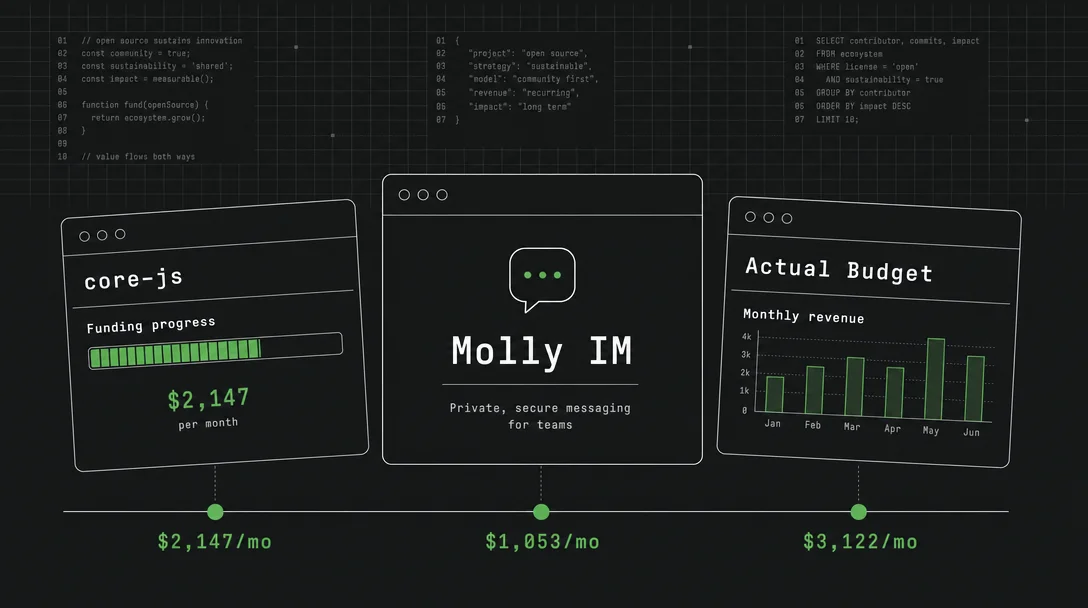
A teardown of the three publicly-verified OSS projects that crossed $1k/month this window — core-js ($2,147/mo), Molly IM ($1,053/mo), and Actual Budget ($3,122/mo) — with funder-composition analysis showing why the same 'Open Collective sponsorship' label conceals three very different funding structures and replicability profiles.

Open Collective keeps publishing its numbers publicly, which makes it the only place right now where this kind of research stays honest. GitHub Sponsors still hides exact earnings by design. Buy Me a Coffee and Polar.sh don't expose structured financial data at the project level. So what follows is based entirely on Open Collective — and the three qualifying projects found this window are worth reading carefully, because they don't share the same funding structure at all.
All three crossed $1k/month. None are corporate-backed. The surface looks similar. The mechanics underneath are not.
core-js — a solo polyfill maintainer at $2,147/month
What it is: core-js is a JavaScript standard library polyfill covering ES2015 through the latest ECMAScript proposals. If your bundler shims
Array.prototype.flatMap or Promise.allSettled for older browsers, there's a reasonable chance core-js is the reason. Denis Pushkarev (GitHub: zloirock) maintains it alone — one Admin on the Open Collective page, 7,819 commits, 25,500 GitHub stars. 1Publicly disclosed monthly earnings: approximately $2,147/month. Open Collective shows an estimated annual budget of $25,758.87 as of June 4, 2026, with $12,576.95 sitting in the current balance. Pushkarev also lists Patreon and Boosty as supplementary channels, but those figures aren't public. 1
Who's actually paying: the top five all-time contributors are Cybozu ($20,017), Bower ($18,800), Workleap ($9,700), GatsbyJS ($9,000), and Babel ($5,000). Five Bronze-tier recurring sponsors at $200/month, 343 Backers at $5/month. The pattern is corporate infrastructure consumers — companies that ship products built on the JavaScript ecosystem and for whom an unmaintained core-js is a direct production risk, not an abstract concern. 1

The model: pure Open Collective sponsorship with a tiered structure (Backer → Bronze → Silver → Gold), no locked features, no dual license, no hosted product. The $1k threshold was cleared by convincing a handful of companies that funding this specific dependency was cheaper than the alternative.
Would this work for you? The replicability here hinges on one factor: does your project sit deep enough in the dependency graph that companies face real maintenance risk if you stop? core-js isn't a nice-to-have. It's a foundational piece of what makes modern JavaScript run on older environments, and companies like Cybozu (a Japanese enterprise SaaS with thousands of customers) can calculate what a broken polyfill layer costs them. If your library can be swapped for an alternative in a week, the corporate risk argument doesn't hold. If replacing it requires an audit of thousands of call sites, companies will fund it to avoid that work.
Molly IM — a 2-person Signal fork at $1,053/month
What it is: Molly is a hardened fork of Signal for Android, started in 2019 as an attempt to add database password encryption — a feature Signal itself has never shipped. It's fully independent: "This project is NOT affiliated with Signal Messenger or the Signal Foundation." 2 The project is maintained by Oscar Mira (GitHub: valldrac) and Dino, with two additional GitHub organization members. Latest release: v8.7.3-2 on April 29, 2026, GPG-signed by valldrac. 3,400 GitHub stars, AGPLv3 licensed.
Publicly disclosed monthly earnings: approximately $1,053/month. Open Collective annual budget: $12,632.65 as of June 4, 2026. Total raised to date: $67,441.99. Total disbursed: $24,935.45 — unlike core-js, Molly has been accumulating reserves. Current balance: $42,506.54. 3

Who's actually paying: the top three all-time contributors are the Monero Community Crowdfunding System ($31,790.83, starting June 2024), Good Ancestor ($5,000), and The Monero Project ($4,210.62). The largest individual donor is Louis Rossmann ($12,000 since September 2023). 118 recurring monthly supporters at $5/month (Friend tier), 785 one-time donors. 3
This funding structure is fundamentally different from core-js. Molly's backers aren't paying to protect a business dependency — they're paying because the project aligns with a specific values community: privacy advocacy, self-hosted infrastructure, and the Monero ecosystem (which has structural incentives to fund FOSS privacy tools). The Monero CCS contribution starting in June 2024 appears to be the event that pushed Molly over the $1k/month threshold.
The model: pure donation/sponsorship via Open Collective, single tier at $5/month, no commercial angle whatsoever. The project funds itself by serving a community that has both the motivation and the means to fund privacy-focused FOSS infrastructure.
Would this work for you? Molly's pattern requires a user base that identifies with a cause strongly enough to fund the infrastructure that serves it. The $5/month recurring tier isn't compensation for a product feature — it's membership in a shared project. And the large institutional contributions from the Monero community reflect a specific ecosystem dynamic: crypto communities often have pooled funding mechanisms (CCS, grants) that mainstream OSS communities lack. If your project happens to serve a community with organized funding infrastructure — privacy advocates, a specific protocol community, an activist network — this structure can work even at modest star counts. At 3,400 stars, Molly is a fraction of core-js's visibility, but it has a more coherent payer base.
The reserve accumulation ($42,506.54 sitting in the account) is also worth noting. This is the opposite of GrapesJS from the prior issue, where the maintainer withdraws nearly everything monthly. Whether that's by design or because the two maintainers don't need to draw heavily yet, it's a different risk profile.
Actual Budget — a 5-person team at $3,122/month
What it is: Actual Budget is an open-source, self-hosted, local-first personal finance application — an envelope budgeting tool in the spirit of YNAB but running entirely on your own infrastructure. 4 The project is maintained by a five-person core team: Matiss, youngcw, MikesGlitch (Admin), Matt Fiddaman, and Joel Jeremy Marquez (Core Contributor). 26,800 GitHub stars, MIT licensed, Node.js.
Publicly disclosed monthly earnings: approximately $3,122/month. Open Collective annual budget: $37,460.60 as of June 4, 2026. Current balance: $33,993.72. Total raised: $48,464; total disbursed: $14,471. The disbursements are traceable — Joel Jeremy Marquez received a January–June 2026 maintainer distribution of $1,101.95, processed June 3, 2026. 4 5
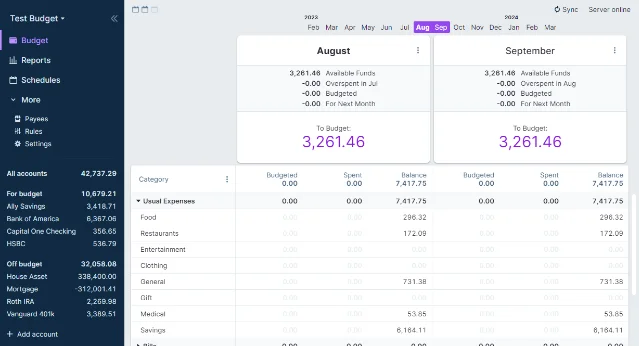
Who's actually paying: Peakford Ltd accounts for $36,009 of the $48,464 raised all-time — 74% of the project's lifetime revenue comes from a single donor. GitHub Sponsors has routed $2,914 to the Open Collective. The broader tier structure (90 Bronze sponsors at $5/month, 2 Silver at $10/month) contributes the rest. 4
That 74% concentration is the headline number here. Actual Budget has more GitHub stars than core-js, a larger team, and a higher monthly figure — but its financial structure is fragile in a way the other two aren't. If Peakford Ltd stops contributing, the project's runway drops dramatically. The team presumably knows this; the $33,993.72 reserve provides a buffer, but it's a different kind of sustainability than 343 Backers each at $5/month.
The model: pure Open Collective sponsorship/donation, no commercial layer. The project funds maintainer time through transparent distributions (visible in the expense records), which is a meaningful signal — sponsors can see their money reaching the people who do the work.
Would this work for you? Actual Budget's star count and community size should theoretically generate more distributed funding than it does. The concentration in a single donor suggests the project hasn't yet successfully converted its large user base into a wide funding base — or that the user base (individual personal finance users, not companies) is simply less inclined to pay for self-hosted FOSS than B2B users are. If your project serves individual consumers rather than companies, the Actual Budget pattern is instructive: you may hit $3k/month, but the path might run through one or two large institutional supporters rather than a thousand small ones.
The $1,101.95 maintainer distribution is also worth noting for teams considering Open Collective: it demonstrates a structure where the project can pay contributors transparently, without those contributors having to pretend the money isn't there. That's the Open Collective use case at its most functional — not just fundraising, but payroll.
The near-misses: 21.5k stars and $70/month
Two diagnostic cases from this window that didn't qualify.
Romuald Członkowski / n8n-mcp (21,523 GitHub stars, MIT license): a MCP server that gives AI assistants access to n8n workflow automation knowledge. GitHub Sponsors page discloses a $3,500/month goal with 2% completion — approximately $70/month from 7 active sponsors. The maintainer's framing is honest: "n8n-mcp is MIT-licensed and free forever. Maintaining it competes directly with my paid consulting work, so every sponsorship is hours I can spend on the project instead of client work." 6 The project has no locked value — sponsors receive almost nothing extra. "Honestly? Almost nothing. No SLA, no priority support, no exclusive features, no private channels." 6
21.5k stars, $70/month. This is the infrastructure trap in its purest form: a project that is genuinely valuable, clearly used, and structurally unable to capture that value through pure donation. The users aren't companies managing a dependency risk; they're developers who use n8n-mcp as part of a workflow and have no organizational mechanism to fund it.
Sindre Sorhus (1100+ npm packages, 20+ billion monthly downloads): Open Collective annual budget of $6,126 — $510/month. Despite being one of the most depended-upon individual contributors in the JavaScript ecosystem, Sorhus's public funding sits well below $1k/month. 7 The scale of dependency doesn't directly translate to funding when no single package is critical enough to trigger the corporate risk calculation that works for core-js.
Model-fit matrix update
Adding this week's three cases to the prior issue's framework:
| Archetype | Tiered sponsorship (OC) | Values-community donation | Single large donor | Professional retainer | Dual license |
|---|---|---|---|---|---|
| Polyfill / compatibility library | ✅ core-js — corporate risk framing works | ❌ Wrong audience | ⚠️ Possible but fragile | ⚠️ Niche use | ❌ Rarely applicable |
| Security fork / privacy tool | ⚠️ Works at small scale | ✅ Molly IM — aligned advocacy community | ✅ If a major org funds the cause | ❌ Hard to structure | ❌ AGPL already handles it |
| Self-hosted consumer app | ⚠️ Low conversion from individual users | ⚠️ Possible with identity community | ✅ Actual Budget — but concentrated risk | ❌ Wrong fit | ❌ Rarely applicable |
| Workflow / integration tool | ❌ n8n-mcp — infrastructure trap | ❌ No identity community | ⚠️ Possible | ⚠️ If users are businesses | ⚠️ Possible |
| Sprawling utility packages | ❌ Sindre Sorhus — no single dependency is critical | ❌ Needs cohesion | ❌ Too diffuse | ❌ Hard to structure | ❌ Not applicable |
One structural pattern across all three qualifying projects: the funder is paying to protect something they depend on, whether that's a business dependency (core-js), an ideological commitment (Molly), or a specific product they've already decided to support (Actual Budget / Peakford). Pure donation that asks users to give without a specific frame for what they're protecting rarely gets past the $500/month ceiling — Sindre Sorhus, with more total impact than any of these three, is sitting at $510/month.
And a note from this week's r/opensource: a thread on whether it's reasonable to resent maintainers for moving projects to paid models drew a blunt observation from a commenter who identifies as a maintainer: "There's a lot of people who could not give less fucks about needing to feed your family, either you give away all your work for free or you're greedy." 8 That sentiment doesn't tell you which model to pick. But it accurately describes the environment in which any of these models have to work.
Cover image: AI-generated illustration.
围绕这条内容继续补充观点或上下文。